
Obstetric Anatomy and Physiology
Placenta at Term
Table of Contents
Definition
The placenta is a temporal vascular inelastic organ of the fetus which acts as a center of vital communication between the maternal blood and fetal blood during intra-uterine life (a round flat mass).
General Characteristics
Size: About $20\text{cm}$ in diameter and $2.5\text{cm}$ in thickness at its center.
Weight: It weighs approximately $1/6$ of the baby’s weight at term, though this may be affected by the time the cord is clamped due to varying amounts of blood retained in the vessels.
Situation: It is usually/normally located in the upper uterine segment. During the $3^{rd}$ stage of Labor it is expelled after separation.
Shape: Circular flat mass.
Structure: Two Surfaces
The placenta has two distinct surfaces: the maternal surface and the fetal surface.
1. Maternal Surface
This surface lies next to the uterine wall and is dark red in color because the basal decidua separates with it.
Cotyledons: The chorionic villi are separated into $16-20$ lobes known as cotyledons.
Septa: These cotyledons are separated by sluices or furrows into which the decidua dips down to form septa (walls). Each cotyledon contains a single villus with its branches.
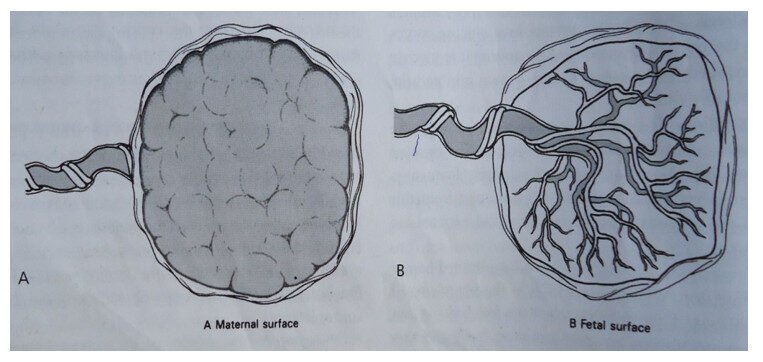
2. Fetal Surface
This side lies next to the fetus in utero, covered by the Amniotic Membrane.
It appears bluish-grey, shiny, smooth, and tough.
Branches of the umbilical arteries and veins are seen running towards the edges of the placenta.
The chorion can be peeled off the surface, leaving the chorionic plate from which the placenta developed and which continues with the chorion.
Join Our WhatsApp Groups!
Are you a nursing or midwifery student looking for a space to connect, ask questions, share notes, and learn from peers?
Join our WhatsApp discussion groups today!
Join Now
We are a supportive platform dedicated to empowering student nurses and midwives through quality educational resources, career guidance, and a vibrant community. Join us to connect, learn, and grow in your healthcare journey
Quick Links
Our Courses
Legal / Policies
Get in Touch
(+256) 790 036 252
(+256) 748 324 644
Info@nursesonlinediscussion.com
Kampala ,Uganda
© 2026 Nurses online discussion. All Rights Reserved