
Obstetric Anatomy and Physiology
Uterine Tubes (Fallopian Tubes)
Table of Contents
Definition
Uterine Tubes (Fallopian Tubes)
These are two muscular canals known as uterine tube or Oviduct.
Situation
- These tubes lie within the broad Ligament of the pelvis on either side of the uterus.
- Each tube extends from the Cornua of the uterus and travels towards the side walls of the pelvis & then turns downwards and backwards before reaching it.
- It opens into the peritoneal cavity near the ovaries.
Shape
Tubular.
Size
7-14cm (average 10cm) in length 3mm-8mm in diameter and 1.25 mm in thickness.
Gross Structure
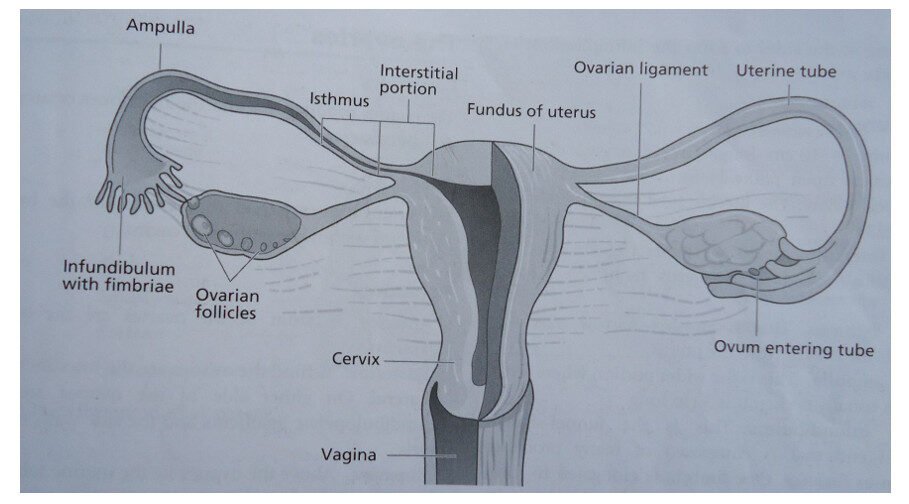
The fallopian tube is divided into 4 parts.
Interstitial Portion
(1.25cm Long) this is the narrowest part of the tube.
This is the area within the thickness of the uterine wall.
Isthmus
The narrow portions immediately adjoining the uterus. It extends 2.5cm from the uterus.
Ampulla
It is the widened out area where fertilization is thought to occur. It’s 5cm long.
Infundibulum or Fimbriated End
This is the terminal portion which turns backward & downward & ends in the finger-like process which surrounds the orifice of the tube.
One of the fimbria being longer than other and is in contact with the ovary. It’s known as fimbria ovarica.
Fallopian Tube in Section (Pictorial Note)
NOTE THE OVUM ENTERING THE FIMBIATED END
The uterine tubes in section; Note the ovum entering the fimbriated end of one.
Microscopic Structure
Ciliated Epithelium
Forms the inner lining of the tube uterus and this assist in the passage of the ovum into the uterus.
The epithelium is arranged in folds known as plicae which slow down the journey of the fertilized ovum thus giving it time to develop and so be ready for embedding when it reaches the uterus.
Connective Tissue
Lies between the epithelium.
Muscle Layer
Arranged in two layers
- Inner Lining of the Circular Fiber
- Outer Layer of the Longitudinal Fiber
Peristaltic movement is due to these muscles which propels the ovum along the tube.
Peritoneum
Hang over the tube but it is absent in their inferior surface.
Blood Supply
From the ovarian & uterine arteries.
Venous Drainage
Into corresponding vein.
Lymphatic Drainage
Into lumbar gland
Nerve Supply
By both motor and sensory parasympathetic and sympathetic nerves, the nerve supply is by the ovarian plexus.
Relations of the Fallopian Tube
Anterior
Posterior
The peritoneal cavity and the intestines.
Superiorly
Inferiorly
Are the broad ligaments and side walls of the pelvis.
Lateral
Infundibulo-pelvic ligament and side walls of the pelvis.
Medial
The uterus.
Supports
The Infundibulo-pelvic ligament these are fold of the broad ligament and run from the Infundibulum of the tube to the side walls of the pelvis.
Functions
- The tube forms the canal through which the ovum and sperms can pass and unite and commence early development (fertilization).
- Propels the fertilized ovum towards the uterus.
- Provides nourishment to the fertilized ovum.
- Passage of the ovum from ovary to the uterus or fertilized ovum to the uterus.
Obstetrical Conditions Associated with Fallopian Tube
Infertility
Investigation show that 30% of women come in infertility clinic.
Pregnancy has been prevented by the obstruction in the fallopian tube which may be partial or complete obstruction due to previous tubal or generalized pelvic inflammation which may result to scarring after inflammation leading to (sterility) infertility.
Ectopic Gestation
When the fertilized ovum remains in the tube and continues to develop, rupture of the tube occurs due to ruptured Ectopic pregnancy.
Sterilization
When further pregnancies are likely to endanger the life (health) of the mother. The obstetrician may carry out an operation containing the clumping and cutting of each fallopian tube and each cut end is then ligatured and buried, there is then no opportunity for the ovum and the sperm to meet and fertilization will not occur.
Join Our WhatsApp Groups!
Are you a nursing or midwifery student looking for a space to connect, ask questions, share notes, and learn from peers?
Join our WhatsApp discussion groups today!
Join Now
We are a supportive platform dedicated to empowering student nurses and midwives through quality educational resources, career guidance, and a vibrant community. Join us to connect, learn, and grow in your healthcare journey
Quick Links
Our Courses
Legal / Policies
Get in Touch
(+256) 790 036 252
(+256) 748 324 644
Info@nursesonlinediscussion.com
Kampala ,Uganda
© 2026 Nurses online discussion. All Rights Reserved