
Tropical Diseases
Onchocerciasis (River Blindness)
Table of Contents
Onchocerciasis, also known as river blindness, is a chronic parasitic disease caused by the nematode worm Onchocerca volvulus. It is characterized by severe itching, skin lesions, and, in advanced cases, blindness. The disease is primarily found in sub-Saharan Africa, with smaller outbreaks in Central and South America.
Transmission
Vector
The disease is transmitted through the bite of infected blackflies (genus Simulium) that live near fast-flowing rivers and streams, hence the name “river blindness.”
Lifecycle
In the Vector (Blackfly)
- The female blackfly ingests microfilariae (larval worms) from an infected human during a blood meal.
- Inside the blackfly, microfilariae develop into infective larvae.
- After approximately 1 to 2 weeks, the larvae mature and migrate to the mouthparts of the blackfly.
In Humans
- An infected blackfly bites a human, injecting the infective larvae into the subcutaneous tissue.
- Larvae migrate to the skin, where they mature into adult worms within 1 to 2 years.
- Adult worms reside in nodules (onchocercomas) beneath the skin and produce microfilariae.
- Microfilariae travel throughout the body, especially to the eyes, skin, and lymph nodes.
- The cycle continues as blackflies ingest microfilariae from infected humans.
Clinical Features
Skin Lesions
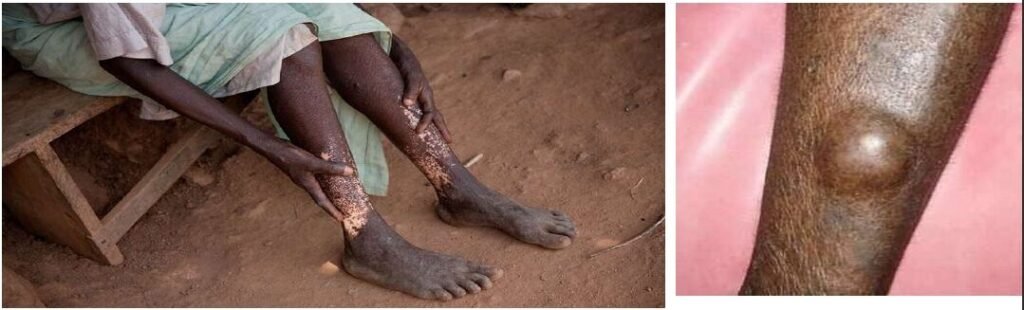
- Papular, itchy skin lesions (onchocercal dermatitis).
- Hyperpigmented or depigmented skin patches.
- Severe itching, leading to secondary bacterial infections.
- “Elephantine” skin thickening, especially on the legs and scrotum.
Eye Involvement
- Microfilariae migrate to the eyes, causing inflammation (onchocercal keratitis).
- Loss of vision, including blindness, due to corneal scarring, optic atrophy, and retinal detachment.
- Severe itching and burning in the eyes.
Onchocercomas
- Firm, subcutaneous nodules that contain adult worms.
- Located in various parts of the body, including the head, neck, limbs, and buttocks.
- Often painful and can cause pressure on nearby nerves or organs.
Lymphatic Involvement
- Swelling of lymph nodes and lymphedema.
- Chronic inflammation of the lymph system.
General Symptoms
- Fever
- Headache
- Fatigue
- Joint pain
- Loss of appetite
- Weight loss
Diagnosis and Investigations
- Skin Biopsy: Examination of skin samples for microfilariae under a microscope.
- Slit-lamp Examination: Examination of the eyes to detect microfilariae and eye damage.
- Nodule Biopsy: Biopsy of onchocercomas to confirm the presence of adult worms.
- ELISA (Enzyme-Linked Immunosorbent Assay): Blood test to detect antibodies against Onchocerca volvulus.
Prevention
- Vector Control:
- Reducing blackfly populations through insecticides and larvicides.
- Using insect repellents and protective clothing.
- Avoiding areas with high blackfly density.
- Mass Drug Administration (MDA):
- Regular administration of antiparasitic drugs (ivermectin) to kill microfilariae.
- Typically given every 6 months to all individuals in endemic areas.
- Ivermectin 150 micrograms/kg once yearly for 10-14 years
Management
Aims of Management
- To eliminate microfilariae and reduce the number of adult worms.
- To prevent further transmission of the disease.
- To manage complications and improve quality of life.
Medical Management
- Antibiotics: For treating secondary bacterial infections.
- Doxycycline: 100 mg twice a day for 6 weeks followed by;
- Antiparasitic Drugs:
- Ivermectin: Kills microfilariae but does not eliminate adult worms.
- Ivermectin 150 micrograms/kg single dose.
- Anti-Inflammatory Medications: For managing eye inflammation and other inflammatory conditions.
Surgical Management
- Excision of Onchocercomas: Surgical removal of nodules can be considered for symptomatic nodules or those causing pressure on nearby structures.
Nursing Care
- Symptom Management:
- Provide comfort measures for itching and pain.
- Administer medications as prescribed.
- Monitor for side effects of medications.
- Eye Care:
- Teach patients proper eye hygiene and care.
- Monitor for signs of eye infection and vision loss.
- Skin Care:
- Provide soothing baths and lotions for itching.
- Encourage the use of insect repellents.
- Education:
- Educate patients about the disease, transmission, and prevention.
- Encourage adherence to treatment and follow-up appointments.
Join Our WhatsApp Groups!
Are you a nursing or midwifery student looking for a space to connect, ask questions, share notes, and learn from peers?
Join our WhatsApp discussion groups today!
Join Now
We are a supportive platform dedicated to empowering student nurses and midwives through quality educational resources, career guidance, and a vibrant community. Join us to connect, learn, and grow in your healthcare journey
Quick Links
Our Courses
Legal / Policies
Get in Touch
(+256) 790 036 252
(+256) 748 324 644
Info@nursesonlinediscussion.com
Kampala ,Uganda
© 2026 Nurses online discussion. All Rights Reserved