
Community Health
Principles, Pillars, and Components/Elements of Primary Health Care
Table of Contents
The Core Structure of Primary Health Care (PHC)
Primary Health Care (PHC) is defined by its foundational components, guiding values, and necessary service deliverables. A successful PHC strategy must adhere to the Pillars that support it, the Principles that guide its delivery, and the Elements that define its content.
I. The Four Pillars of PHC (Support System)
The Pillars represent the key governmental and societal supports required to enable PHC implementation.
Political Commitment/Will
Definition: Active involvement and sustained interest from political leaders in policy formation and resource allocation for PHC programs.
Focus: Ensures healthcare remains a national priority and guarantees adequate resource allocation and community mobilization.
Multi/Intersectoral Collaboration
Definition: Mandatory collaboration across various government and non-governmental sectors (e.g., health, agriculture, education, housing).
Focus: Promotes continuity and sustainability of health services by recognizing that health outcomes are influenced by factors beyond the health sector alone.
Community Participation and Development
Definition: Active involvement of the community in planning, implementation, and development of health services.
Focus: Ensures programs are socially acceptable and sustainable, tailoring healthcare to local needs and fostering a crucial sense of ownership.
Appropriate Technology
Definition: Technology that is scientifically sound, practically available, adaptable to local needs, and economically viable.
Focus: Ensures healthcare delivery is effective, accessible, and affordable using simple, locally produced, and easy-to-use methods (e.g., using ORS instead of I.V. fluids).
II. The Principles of PHC (Guiding Values)
The Principles are the core values and philosophical guidelines that dictate how PHC is delivered to achieve health equity.
Equitable Distribution (Equity and Access)
Definition: Healthcare services must be equally shared by all people in the community, irrespective of race, creed, or economic status.
Focus: Decentralization of services, shifting accessibility from cities to rural areas where the most vulnerable populations reside, making this the most important guiding value of PHC.
Community Participation
Definition: Meaningful involvement of the community in planning, implementing, and maintaining their health services.
Focus: Maximizing the utilization of local resources (manpower, money, and materials) to fulfill PHC goals. This principle leads to the training of local cadres like Community Health Workers (CHWs).
Inter-sectoral Collaboration
Definition: Involvement of sectors beyond health (e.g., agriculture, education, communication) to improve the health of local people.
Focus: Recognizing the social determinants of health and improving outcomes through shared efforts (e.g., education on diet/nutrition values).
Appropriate Technology
Definition: Technology that is scientifically sound, adaptable to local needs, acceptable to those who apply it, and economical.
Focus: Choosing methods that are cheaper, easy to use, and locally produced (e.g., advising on Neem sticks for oral hygiene instead of expensive toothbrushes).
Self-Reliance
Definition: Encouraging individuals, families, and communities to transition from being passive recipients of aid to active partners in their health, with or without external support.
Focus: Fostering independence and sustainability within the community’s health efforts.
Prevention Focus
Definition: The emphasis on preventing disease and promoting health runs through all elements of PHC.
Focus: Utilizing all levels of prevention: Primordial, Primary, Secondary, and Tertiary, to proactively address health challenges.
III. The Elements of PHC (Essential Health Care)
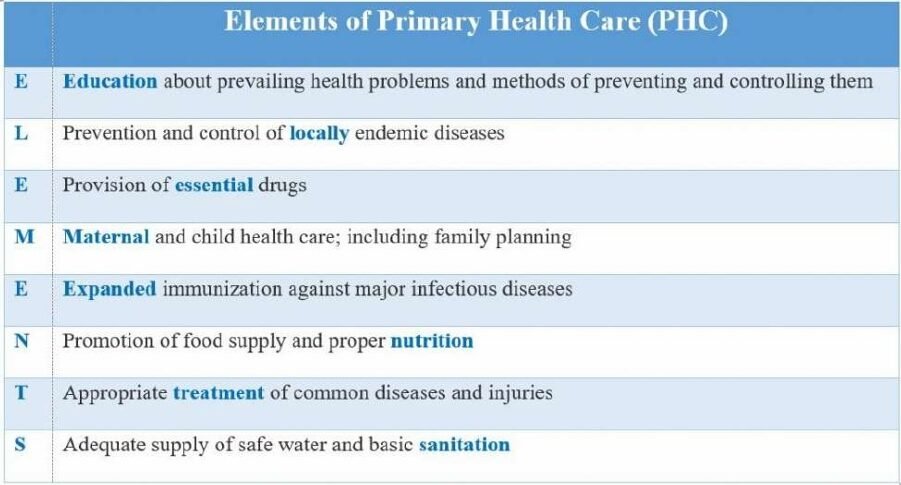
These are the eight core components, or essential health care services, that PHC programs must deliver. The content below reflects the expanded components utilized in regions such as Uganda.
Health Education: Providing information on prevalent health problems and methods of prevention and control.
Promotion of Food Supply and Proper Nutrition: Ensuring adequate and healthy food sources.
Adequate Supply of Safe Water and Basic Sanitation: Addressing environmental factors that contribute to disease.
Maternal and Child Health Care, including Family Planning: Comprehensive care across the reproductive lifecycle.
Immunization against Major Infectious Diseases: Protecting children and populations from preventable illnesses.
Prevention and Control of Locally Endemic Diseases: Targeting specific diseases prevalent in the community.
Appropriate Treatment of Common Diseases and Injuries: Providing basic clinical care.
Provision of Essential Drugs: Ensuring access to necessary, basic medicines.
Expanded Components for Comprehensive Care
In many contexts, including Uganda, the scope of PHC has been expanded to ensure holistic care:
Dental Health and Oral Care: Promotion of oral hygiene and provision of basic dental treatment.
Mental Health (Community Mental Health): Care, rehabilitation, and prevention of mental illnesses within the community.
Rehabilitative Health Services: Community-based programs for individuals with physical and mental disabilities to promote independent living and community integration.
STI/HIV/AIDS Prevention and Care: Comprehensive efforts for prevention, control, treatment, and care.
Eye Care (Primary Comprehensive Eye Care): Prevention of eye problems through health education, treatment, and referral for individuals with eye issues.
Join Our WhatsApp Groups!
Are you a nursing or midwifery student looking for a space to connect, ask questions, share notes, and learn from peers?
Join our WhatsApp discussion groups today!
Join Now
We are a supportive platform dedicated to empowering student nurses and midwives through quality educational resources, career guidance, and a vibrant community. Join us to connect, learn, and grow in your healthcare journey
Quick Links
Our Courses
Legal / Policies
Get in Touch
(+256) 790 036 252
(+256) 748 324 644
Info@nursesonlinediscussion.com
Kampala ,Uganda
© 2026 Nurses online discussion. All Rights Reserved