

On This Page
Sample Size Determination
Sample size determination, also known as sample size calculation or sample size estimation, is the process of determining the number of individuals or items to be included in a sample from a larger population for a research study.
- Sample size is abbreviated as n
- Study/Accessible Population is abbreviated as N
- Margin of error is abbreviated as e (0.05 at 95% Confidence level)
FACTORS TO CONSIDER WHILE DETERMINING THE SAMPLE SIZE
- Research Objectives: Different objectives may require different sample sizes to achieve meaningful results. 📚
- Population Size: Larger populations necessitate larger sample sizes to ensure representativeness. 🏢
- Sampling Error: Smaller margins of error require larger sample sizes. ±📏
- Confidence Level:Higher confidence levels generally result in larger sample size requirements. 🎯 expressed as a percentage (e.g., 95% confidence level).
- Research Design: The chosen research design, whether experimental, observational, qualitative, or quantitative, can impact sample size. Each design has its own requirements. 📊🔍
- Data Collection Methods: The methods used to collect data, such as surveys, interviews, or observations, can influence the sample size. 📝🎙
- Budget and Resource: Practical limitations, including budget constraints and available resources, can also influence your sample size decisions. 💰
- Time: The time available to conduct the study can impact the sample size. Tight timelines may necessitate smaller, more manageable samples. ⏰
- Ethical Considerations: Ethical principles, such as minimizing harm to participants, can influence sample size decisions, particularly in sensitive research areas. 🤝
- Statistical Software and Tools: The availability of statistical software and tools for sample size calculations can streamline the process, ensuring accuracy in your estimates. 📈🖥️
HOW TO DETERMINE SAMPLE SIZE
1. Census (for Small Populations):
A census involves including every member of the population in your sample. This method is highly advantageous for small populations because it eliminates sampling errors and provides data on every individual in the population.
NOTE: census is only feasible for small populations. Conducting a census for large populations may not be cost-effective and practical.
2. Transfer from a Similar Study:
Another approach is to transfer the sample size from a similar study with comparable objectives and characteristics. This strategy can save time and resources.
A potential disadvantage is that you might repeat the mistakes made in the previous study. Ensure the previous study was methodologically sound.
3. Using Internet Sample Size Calculators: This method utilizes the Internet sites that help one to determine the sample.
One Examples is: https://www.calculator.net/sample-size-calculator.html

4. Utilizing Published Tables:
Researchers can make use of published tables designed for sample size determination. One such example is the Krejcie & Morgan table of 1970, which helps researchers determine the sample size for a given population. Another example is Glenn(1992).
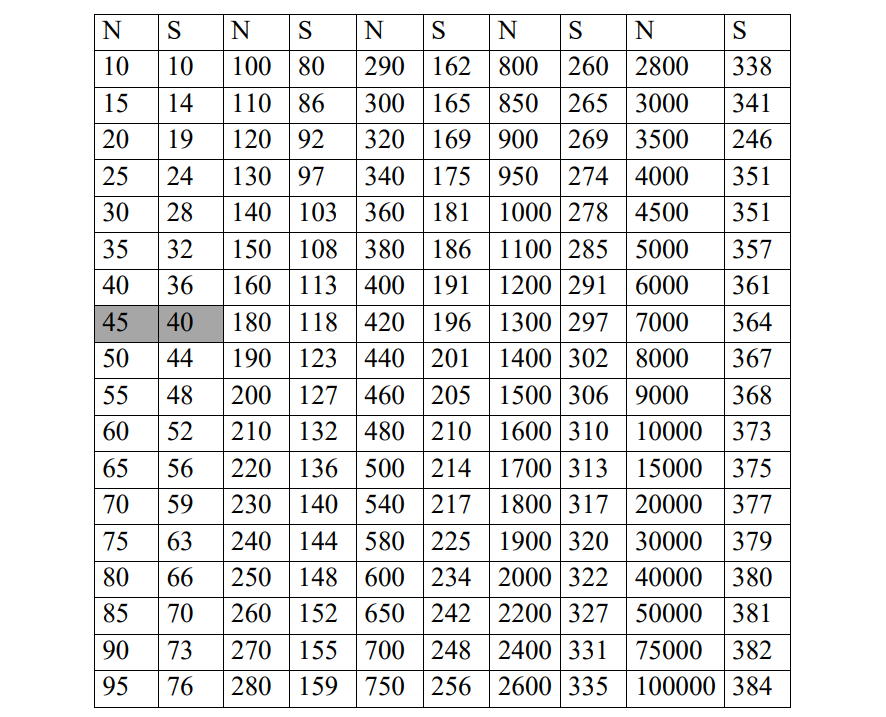
WHERE:
- N is the Population
- S is the Sample size you need to draw.
For example a For a population of 45 people, Krejcie & Morgan table advises a Sample of 40 people.
For 10 people, Sample is 10, requiring a Census due to the small number of people.
These tables are a valuable resource and provide guidance on sample size selection, taking into account factors like population size, confidence levels, and error margins.
5. Applying Standardized Formulas:
A widely accepted method involves applying standardized sample size formulas, such as the one developed by
Kish and Leslie in 1965.
The formula is as follows:
n = Z²pq / d²,
where
- Target Population: 500 diabetic patients attending Goma Health Center in Mukono District.
- Confidence Level: 95%
- Margin of Error: 5% (0.05)
- Prevalence: historical data indicating that around 40% of patients at Goma Health Center are diabetic (p = 0.40).
Using Kish and Leslie Formula:
n = Z²pq / d²
Where:
- n = Sample size
- Z = Z-score for the desired confidence level (1.96 for 95% confidence)
- p = Assumed true population prevalence of diabetic patients
- q = Complement of p (1-p)
- d = Margin of Error (0.05)
n = (1.96)² X 0.40 X (1 – 0.40) / (0.05)²
n ≈ 346.18
In this scenario, you would need a sample size of approximately 347 diabetic patients attending Goma Health Center in Mukono District to estimate the true population prevalence with a 95% confidence level and a 5% margin of error.
II. Yamane formula, developed by Taro Yamane in 1967.
The formula is as follows:
n = N / (1 + Ne²)
Where:
- n = Sample size
- N = Population size (500)
- e = Desired level of precision (0.05)
n = 500 / (1 + 500 X (0.05)²)
n ≈ 333.33
In this scenario, you would need a sample size of approximately 333 diabetic patients attending Goma Health Center in Mukono District to achieve the desired level of precision (5%).
6. USING UNMEB GUIDELINES
3.4.2 SAMPLING PROCEDURE
A sampling procedure is a defined and systematic method for selecting a subset (sample) from a larger group (population) for the purpose of conducting research or collecting data.
It involves the steps and techniques used to ensure that the sample accurately represents the population, allowing researchers to draw meaningful conclusions from the sample’s data.
High-Yield Clinical Summary: Sample Size Determination
| Clinical Section / Focus | Key Features & Exam Points | Nursing Management & Rationale |
|---|---|---|
| Sample Size Determination | Sample size determination, also known as sample size calculation or sample size estimation, is the process of determining the number of indivi… | Sample size is abbreviated as n |
| FACTORS TO CONSIDER WHILE DETERMINING THE SAMPLE … | Research Objectives: Different objectives may require different sample sizes to achieve meaningful results. 📚 | Population Size: Larger populations necessitate larger sample sizes to ensure representativeness. 🏢 |
| HOW TO DETERMINE SAMPLE SIZE | 1. Census (for Small Populations): | A census involves including every member of the population in your sample. This method is highly advantageous for small populations because it… |
| 4.2 SAMPLING PROCEDURE | A sampling procedure is a defined and systematic method for selecting a subset (sample) from a larger group (population) for the purpose of co… | It involves the steps and techniques used to ensure that the sample accurately represents the population, allowing researchers to draw meaning… |